Rising mortgage rates have left homeowners with little reason to move.
The surge in borrowing costs has reshaped the housing market — and why homeowners who locked in rock-bottom rates during the pandemic have so little incentive to move.
The typical existing mortgage holder has a 3.88% rate and pays $1,597 a month, according to ICE Mortgage Technology data cited by Barron’s.
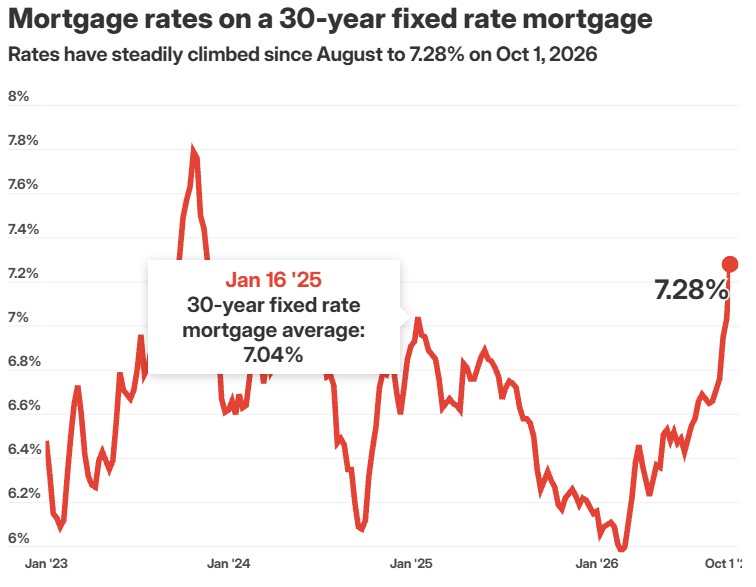
But mortgage rates have recently surged to around 7.3%.
At that rate, a buyer putting 20% down on the $429,100 median-priced home would face a monthly principal-and-interest payment of about $2,353 on a 30-year mortgage, Barron’s calculated. That’s $756 more every month — or roughly 47% higher — than the median payment shouldered by current mortgage holders.
The enormous gap helps explain the so-called mortgage-rate lock-in effect that has dogged the housing market since borrowing costs began climbing.
Millions of Americans refinanced or purchased homes when mortgage rates plunged during 2020 and 2021. Those loans have become increasingly valuable as prevailing rates have more than doubled.
Source: FRED / Barons
Mortgage Rates
Average 7.4%
As market conditions continue to evolve, borrowers should remember that shopping around for a mortgage rate and getting multiple quotes can potentially save them thousands over the loan’s lifetime.
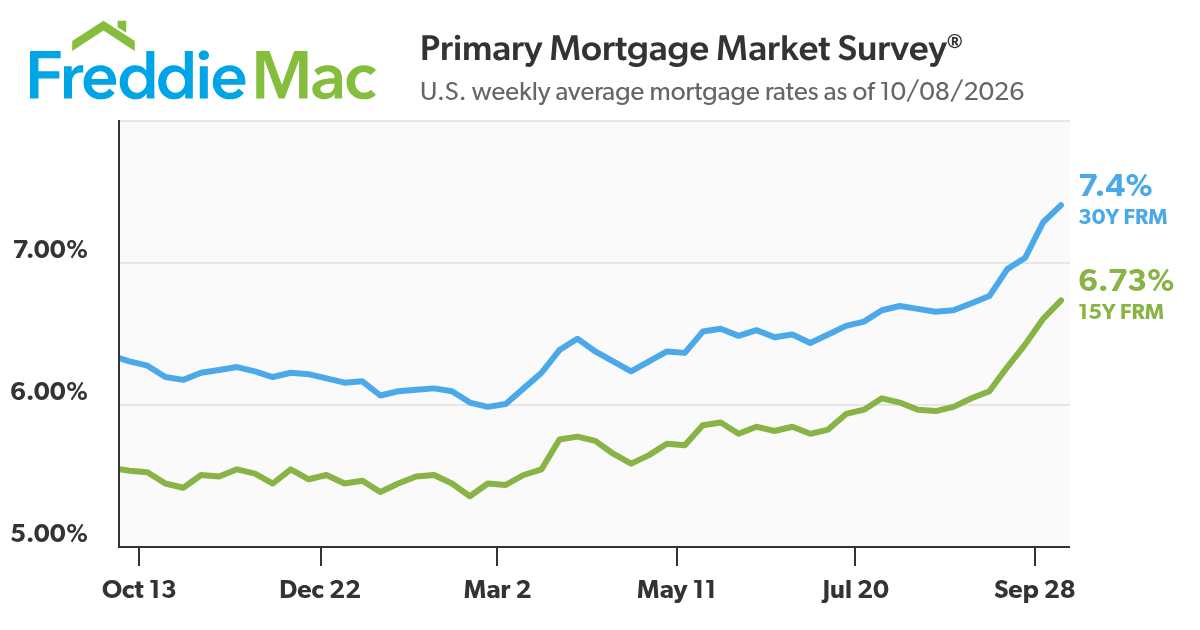
The 30-year fixed-rate mortgage averaged 7.40% as of October 8, 2026, up from last week when it averaged 7.28%. A year ago at this time, the 30-year FRM averaged 6.30%.
The 15-year fixed-rate mortgage averaged 6.73%, up from last week when it averaged 6.60%. A year ago at this time, the 15-year FRM averaged 5.53%.