
• Skip to main navigation
  • Skip to content
  • Skip to footer

Doiron Realty ServicesDoiron Realty Services

On the Gulf Coast

  • Home
  • About Us
  • Contact Us
  • FAQ
  • Representation
  • Gulf Coast Real Estate News
  • Gulf Front Condos by Building
  • Real Estate Commission Lawsuit
SearchClose

COVID-19 and The Pinellas County Real Estate Market 1st two weeks of April

Here is a snapshot of the first two weeks of April 2020 compared to the first two weeks of April in 2019. You can see under the column entitled “Number of New Contracts” 528 new residential deals went in to escrow between April 1st and April 15th of this year. That is down 26.4% from last year during the same period which translates to a 101 day supply County wide as shown in the column entitled “Number of Days Supply” Also note worthy is the column entitled “Number of Canceled Listings”, which represents properties that were for sale and withdrawn from the market either temporarily or permanently. The chart also shows the difference in median sales prices from the same periods and the current supply of existing inventory. St. Petersburg, the Beaches and Seminole markets are broken out for your review as well. 
Stay safe.

Posted in: Uncategorized

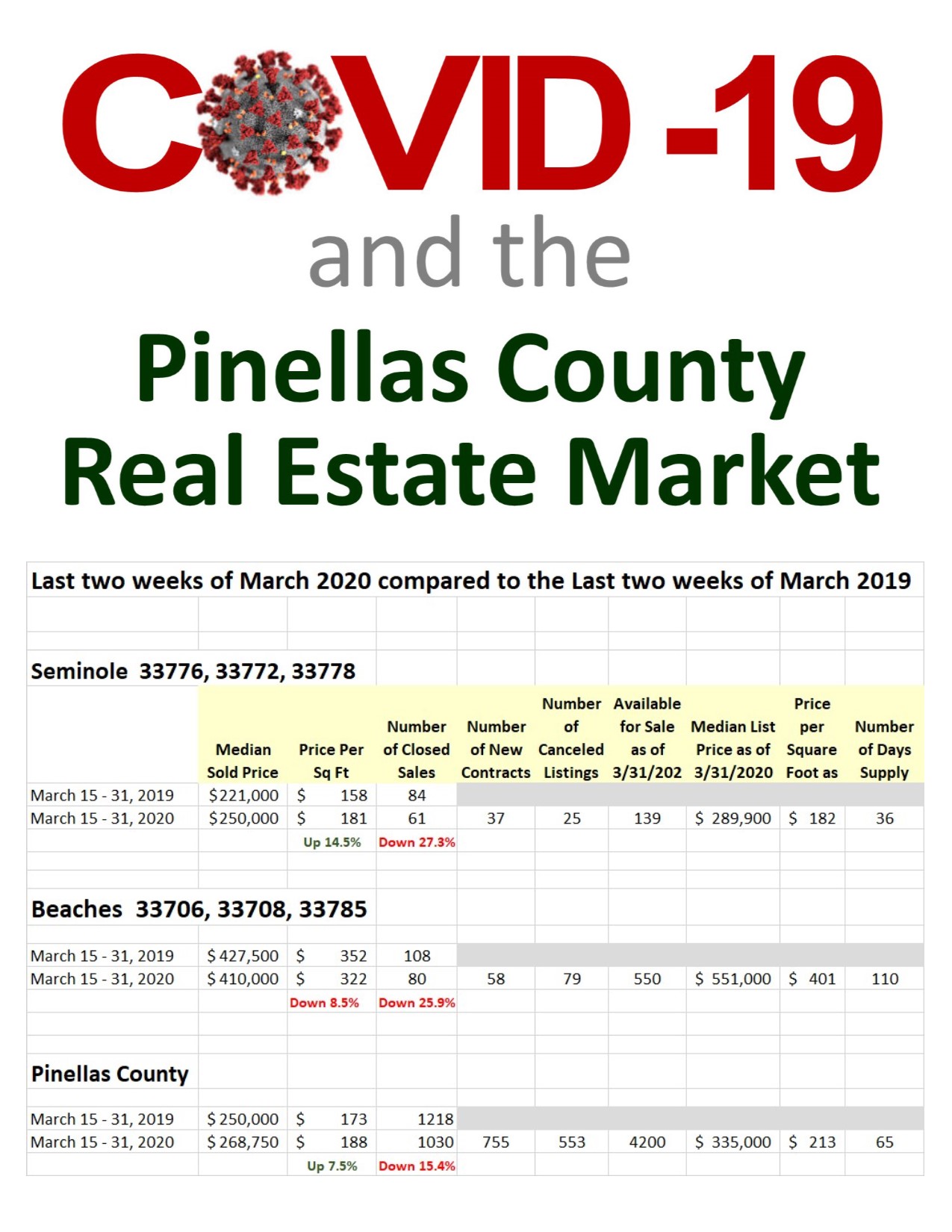
COVID-19 and The Pinellas County Real Estate Market

Here is a snapshot of the last two weeks of March 2020 compared to the last two weeks of March in 2019. You can see under the column entitled “Number of New Contracts” 755 new residential deals went in to escrow between March 15 and March 31 of this year. Number of closed sales is down about 15% from last year during the same period but still rather encouraging. The chart also shows the difference in median sales prices from the same periods and the current supply of existing inventory. Beaches and Seminole markets are broken out for your review as well. 

Stay safe.

Posted in: Uncategorized

Looking Back Ten Years

It’s hard to believe that 10 years have passed since the low point of the Great Recession. The whole country experienced the greatest real estate value correction since the Great Depression of 1929. Some states were hit harder than others and as we all know all to well, Florida sustained quite a blow. Short sales, REO’s, foreclosures comprised a bulk of the market and it was not a good time. Institutional investors invaded the single-family market in wholesale acquisition mode. Lenders were inept at dealing with the sheer magnitude of the problem and Real Estate attorneys had a field day. The Fed stepped in, banks got bailed out, some borrowers were fortunate enough to be granted a mortgage modification, rates dropped and it was pretty miserable. But eventually the word “recovery” started getting tossed around in the mid-2000s quite a bit and for all intents and purposes low and behold we eventually recovered.


As the saying goes “real estate is local” so let’s take a look at the changes in the Pinellas County market in the last 10 years. The graphs below summarize the last 10 years of Pinellas County’s residential real estate market. The data I used is compiled from our local MLS and is comprised of closed sales from the last quarter of each year.

The low point of the market was 2011 with 1,839 residential properties sold with a median sale price of $187,000. Fast forward to 2019 and you can see we closed out 2019 with 4,751 properties selling at a median sale price of $262,000. In summary two and a half times the number of homes sold in 2019 versus 2011 and the median sale price rose 40% over the same period. That’s a healthy recovery in anybody’s book. I’ll take it, thank you. And in case you’re wondering; the prior peak was in 2005 with 4,590 properties sold at a median sales price of $221,000 which is nearly identical to 2016.

The forecast for 2020 looks optimistic with mortgage rates and unemployment at record lows. Not to mention more and more people are moving to Florida every year… over 900 a day according to State economists. Here’s a question for you. Where else in Florida would you rather be? Miami, Fort Lauderdale, Orlando? Think about it. The Tampa Bay area has it all… beautiful clean beaches, employment, recreation, one the best airports in the country, professional sports, nice people.

In closing, I wish you all the best in 2020 and don’t hesitate to call me anytime with a real estate question. 

Your Broker

Pete Doiron

Posted in: Uncategorized

November Snapshot

Looking at a snapshot of November of last year compared to November of this year we can see the difference in market conditions leading up to the Holiday Season.

The number of homes for sale in November this year was down considerably at 21.7%. This corresponds with the number of homes sold in November which was down by 9.5%. This is an indication that some sellers are less inclined to make a move and stay put.

With less homes for buyers to choose from and mortgage rates down a full point from this time last year the median sales price has increased 4.4%. The time it takes to sell remains relatively unchanged at an average of 57 days.

Posted in: Uncategorized

Homestead Portability

You can take it with you… 

In the last Blog Post we covered the Save Our Homes Cap (SOH) and how it can save you thousands of dollars on Real Estate taxes for as long as you live in your home. Now let’s take a look at how you can take those savings with you if you decide to move.

These benefits can transfer if you UPSIZE or DOWNSIZE to any home located in any County in the State of Florida.

If you are upsizing it’s a fairly simple calculation; you take your accumulated amount of your SOH cap and transfer it to your new home and your Assessed Value drops accordingly. Then subtract your $50,000 Homestead Exemption to arrive at your taxable value..

If you are downsizing you transfer a percentage of your SOH benefits. This is calculated by dividing the Just Value of your new home by the Just Value of your old home. This will give you a percentage ( in our example below it is 75% ). Now multiply your accumulated SOH differential from your old home times the percentage to determine the new SOH reduction. Then subtract your $50,000 Homestead Exemption to arrive at your taxable value. (see below)

Downsize formula: $300,000 / $400,000 = .75

.75 x $150,000 = $112,500

To see what your current SOH value is you can go to the Pinellas County Property Appraiser website: https://www.pcpao.org/. On the left side bar click Search Our Database then By Address. Enter your address and you will be taken to a link, click the link to proceed to your full property record. Note the Just/Market Value and the Assessed Value in the most recent tax year. Subtract Assessed Value from Just/Market Value and that is your accumulated SOH benefit.

If you, a family member or friend have sold a home this year make sure you or they file Homestead and apply for a transfer of the accumulated SOH benefit by the end of the year.

If you have any questions please give me a call.

Best regards,

Your Broker

Pete Doiron


Posted in: Uncategorized

Your Home and The Pinellas County Tax Collector


If you are like many Americans you believe that purchasing a home is a sound financial decision. The advantages are many, including equity build up, pride of ownership and the fact that you’re not subject to the whims of a landlord. Each year when you file your income taxes you can write off your itemized Real Estate taxes and mortgage interest which in turn reduces your federal tax burden. Your home is also your “homestead” which saves you money on those county real estate taxes. Most everyone knows that the standard homestead deduction is $50,000. So, if your homes assessed value is $400,000 that $50,000 homestead comes off the top thereby reducing your taxable (assessed value) to $350,000 which saves you about $1,000 per year depending on the municipality you live in.

But the real benefit is the “save our homes cap” (SOH). The SOH cap limits the increase of your homes taxable value each year. The maximum increase in taxable value is limited to 3% or the annual consumer price index (CPI) whichever is lower. (Note CPI for 2019 is on track to be 1.8%). The SOH has been in effect since 1992 when Florida voters approved the amendment to the Florida Constitution to prevent homeowners from being “taxed out” of their homes in an escalating market. For example, assessed values jumped about 25% in Pinellas County in one year alone from 2015 to 2016.  ( See below )

Those savings really ad up. SOH accumulates a value differential every year in an escalating market, so while the market value of your home is going up your real estate taxes are kept in check.

When you do decide to sell: the new buyer starts the process from whatever the assessed value without SOH is at the time of the sale. It’s not uncommon for the taxes on a property to increase dramatically after a sale especially if the seller has owned the property for a number of years.

The good news for the seller is that SOH differential is “portable” if the seller buys another home in Florida. The difference in SOH value and Market Value can be transferred to the new home.  Stay tuned for the next blog post “ You can take it with you “ for details.


Posted in: Uncategorized

Could you benefit from a 1031 Exchange?

Let’s assume that you purchased an investment property for $500,000 and you have held the investment for 10 years. To keep things simple for this example we will assume that you payed cash and you have not mortgaged the property. The value of the property now is $1,000,000.  To minimize your taxes over the 10-year holding period you have accumulated $182,000 in depreciation. Let’s calculate your capital gain If you were to sell the property today for $1,000,000.

Purchase Price (Basis) $                                      500,000
Accumulated Depreciation $                                      182,000
Adjusted Basis $                                      318,000
  
Sale Price $                                   1,000,000
Sales Costs $                                        70,000
Net Proceeds $                                      930,000
Minus Adjusted Basis $                                      318,000
Capital Gain $                                      612,000


You have a Capital Gain of $612,000… Congratulations, assuming you are in the top marginal tax rate for 2019 of 37% you will have a capital gains tax liability of 20% or $122,400.

Enter the 1031 exchange.

Your $612,000 proceeds from the sale of the (relinquished property) is placed with a (Qualified Intermediary).

Essentially, you now have 45 days to identify a potential (replacement property) or properties and have 180 days to complete a purchase totaling $1,000,000 and put that $612,000 to work as equity in the replacement property or properties and subsequently avoiding the capital gains liability… for now.

If you sell the replacement property in the future you will be responsible for the capital gains tax at that time unless of course you elect to do another 1031 exchange. I have had clients roll gains in to 1031 exchanges multiple times over the years and many investors elect 1031’s as a matter of course.

Fees charged by Qualified Intermediaries are very reasonable, generally in the $1,000 to $2,000 range. I have worked with several over the years and would be happy to refer one if you have any questions. Of course, my example above covers the basics and you should consult a 1031 Tax specialist and your CPA for specifics.

Happy Investing

Pete Doiron

Broker – Doiron Realty Services


Posted in: Uncategorized

What’s Your Home Actually Worth?

What’s Your Home Actually Worth?
Discover What Buyers Will Pay in Today’s Market

It’s easy to look up how much money you have in your savings account or the real-time value of your stock investments. But determining the dollar value of a home is trickier.

As a seller, knowing your home’s worth helps you price it correctly when you put it up for sale. If you price it too high, it may sit on the market. But price it too low and you may be losing out on a good chunk of money (nobody wants that!). For buyers, it’s important to know a home’s worth before you make an offer. You want your offer to be competitive, but you don’t want to overpay for the property.

Even if you’re not a buyer or seller right now, as a current homeowner you might just be curious about the value of your home. Keeping track of your home’s worth year over year helps you understand the trends in your market. So when you are ready to sell, you can take advantage of a good window of opportunity.

The good news is, a trained real estate agent—who understands the nuances of your particular neighborhood—can determine the true market value of your property … and at no cost to you!

THE THREE TYPES OF HOME VALUES

When you start the process of buying or selling a home, you’ll frequently hear the words appraised value, assessed value, and true market value. It’s important to know the difference between each one so you can make better, informed decisions.

Appraised Value

A professional appraiser is in charge of determining the appraised value of a home. These appraisals are typically required by a lender when a buyer is financing the property. And while the lender is the one requiring this information, the appraiser does not work for the lender.1 Your appraiser should be an objective, licensed professional who doesn’t have allegiance to the buyer, seller, or lender—no matter who is paying their fee.

The number the appraiser comes up with (the appraised value) assures the lender that the buyer is not overpaying for the property. For example, imagine a seller lists a home for $400,000. They reach a deal with the buyer to sell the home for $375,000. However, if an appraiser evaluates the property and determines that the appraised value is actually $325,000, then the lender will not lend for an amount higher than that appraised value of $325,000.2

When figuring out this number, an appraiser will compare the property to similar homes in your neighborhood, and they’ll evaluate factors such as location, square footage, appliances, upgrades, improvements, and the interior and exterior of the home. 

Assessed Value

The assessed value of a home is determined by your local municipal property assessor. This value matters when your county calculates property taxes each year. The lower your assessed value, the less property tax you’ll pay.3

To come up with this value, your assessor will evaluate what comparable homes in the neighborhood have sold for, the size of your home, age, overall condition, and any improvements or upgrades that have been made. However, most assessors don’t have full access to your home, so their information is limited.

Assessments are done annually to determine how much property tax you owe. Many counties use a multiplier (typically between 60%-80%) to calculate the final assessed value. So, if the assessor determines that the value of the home is $300,000, but the county uses a 70% multiplier, the assessed value of the home would be $210,000 for tax purposes.4

If your assessed value isn’t as high as you envisioned, don’t sweat it. Many homeowners appeal their assessment in favor of a lower valuation so that they can save money on property taxes. If you’re interested in appealing your property tax assessment, let us know. We offer complimentary assistance and would be happy to help you build your case.

True Market Value

True market value is established by your real estate agent. It basically refers to the value that a buyer is willing to pay for the property. A good real estate agent is an expert in determining true market value because they have hands-on experience buying and selling properties. They understand the mindsets of buyers in your market and know what they’ll pay for a desirable house, townhouse, or condo.

As a seller, knowing your true market value is important because it helps you choose how much to list your property for. It can also help you decide if you want to make any improvements to your home before putting it on the market. Your agent can help you figure out which updates and upgrades will have the biggest impact on your true market value.

WHAT’S THE DEAL WITH ONLINE CALCULATORS?

When figuring out your home’s value, you might be tempted to see what popular real estate sites like Zillow, Redfin, and Trulia have to say. When you use an online calculator to determine your home’s value on these sites, it is just an estimate. It’s not an actual appraisal or the “true market value.” These sites all have their own algorithms for coming up with their estimates. For example, Zillow comes up with their “Zestimates” by calculating “public and user-submitted data, taking into account special features, location, and market conditions.” 5

These online estimates can be a great starting point for opening up the conversation with your real estate agent about your home’s worth. But even Zillow recommends that you use a real estate agent for coming up with the actual market value of your home. The site says that once you get your “Zestimate,” you should still get “a comparative market analysis from a real estate agent.”

Having an agent involved in this process is essential because they understand the market better than a computer ever could. They’re showing property in your city every single day, and they know the particular preferences of buyers and sellers in the area. Young professionals, large families, empty nesters, and other groups are all looking for different things in a home. A local agent has most likely worked with all of them, so they understand what every segment in your market is specifically looking for.

HOW AN AGENT FINDS YOUR HOME’S TRUE MARKET VALUE 

So, how does an actual real estate agent determine true market value? They’ll start by doing a comparative market analysis (CMA). This means they’ll compare your home’s features to similar properties in your area. For the CMA, the agent looks at the below factors to influence their assessment of your home’s worth:6

●     Neighborhood sales – Your agent will look at similar, recently sold homes in your neighborhood to see what they sold for and what they have in common with your house.

●     The exterior – What does your home look like from the outside? Your agent will factor in curb appeal, the style of the house, the front and backyard, and anything else that impacts how the house looks to everyone walking and driving by.

●     The interior – This is everything inside the walls of the house. Square footage, number of bedrooms and bathrooms, appliances, and more all influence the overall market value.

●     Age of the home – Whether you have a newer or older home affects the number your agent comes up with as part of their assessment.

●     Style of the home – The style of your home is important because buyers in different markets have different tastes. If buyers prefer ranch-style homes and you have one, then your home may sell for a premium (aka more money!).

●     Market trends – Because a local agent has so much experience in your market, they have their finger on the pulse of your area’s trends and know what buyers are willing to pay for a property like yours.

●     Location, location, location – This one’s probably the most obvious. Your agent will think about how popular the area is, how safe it is, and what schools are like.

A computer algorithm simply can’t take all of these factors into account when calculating the value of your home. The reality is, nothing beats the accuracy of a real estate agent or professional appraiser when it comes to determining a home’s true market value.

YOUR AGENT IS THERE EVERY STEP OF THE WAY

Determining a home’s true market value is a professional real estate agent’s forte. If you’re a seller, I will help you find your home’s market value so you can list it at the right price.

Get a Complimentary Report With Your Home’s True Market Value

Curious about your home’s true market value? Call me to request a free, no-obligation Broker Price Opinion to find out exactly how much your home is worth!

Pete Doiron

Broker

 Sources:

 Chicago Tribune –

https://www.chicagotribune.com/suburbs/chi-ugc-article-what-is-the-difference-between-market-value-a-2013-09-30-story.html

  1. SFGATE –

https://homeguides.sfgate.com/market-value-vs-appraised-value-1206.html

  1. ValuePenguin –

https://www.valuepenguin.com/mortgages/what-is-the-assessed-value-of-a-house

  1. Movoto –

https://www.movoto.com/blog/homeownership/assessed-value-vs-market-value/

  1. Zillow –

https://www.zillow.com/how-much-is-my-home-worth/

  1. Realtor.com –

https://www.realtor.com/advice/sell/assessed-value-vs-market-value-difference/


Posted in: Uncategorized

Financing

s the events of the last few years in the real estate industry show, people forget about the tremendous financial responsibility of purchasing a home at their peril. Here are a few tips for dealing with the dollar signs so that you can take down that “for sale” sign on your new home.

Get pre-approved. Sub-primes may be history, but you’ll probably still be shown homes you can’t actually afford. By getting pre-approved as a buyer, you can save yourself the grief of looking at houses you can’t afford. You can also put yourself in a better position to make a serious offer when you do find the right house. Unlike pre-qualification, which is based on a cursory review of your finances, pre-approval from a lender is based on your actual income, debt and credit history. By doing a thorough analysis of your actual spending power, you’ll be less likely to get in over your head.

Choose your mortgage carefully.Used to be the emphasis when it came to mortgages was on paying them off as soon as possible. Today, the debt the average person will accumulate due to credit cards, student loans, etc. means it’s better to opt for the 30-year mortgage instead of the 15-year. This way, you have a lower monthly payment, with the option of paying an additional principal when money is good. Additionally, when picking a mortgage, you usually have the option of paying additional points (a portion of the interest that you pay at closing) in exchange for a lower interest rate. If you plan to stay in the house for a long time—and given the current real estate market, you should—taking the points will save you money.

Do your homework before bidding. Before you make an offer on a home, do some research on the sales trends of similar homes in the neighborhood with sites like Zillow. Consider especially sales of similar homes in the last three months. For instance, if homes have recently sold for 5 percent less than the asking price, your opening bid should probably be about 8 to 10 percent lower than what the seller is asking.

Posted in: Uncategorized

Preparing to Sell

Selling your home doesn′t just mean hiring a realtor to stick a sign out front. There are a lot of preparations you should make to ensure you get the best offer possible in the shortest time.

Repair. Just because you’ve gotten used to the cracks in the walls and the rattles in the radiators doesn’t mean a buyer will too. If you have hardwood floors that need refinishing, be sure to get it done—hardwood is a huge selling point. Buyers like to snoop around, so be sure to fix any sticky doors or drawers as well. Finally, don’t forget to address any issues with the exterior—fences, shingles, sidewalks, etc. After all, without curb appeal, some buyers may never get to see the inside.

Neutralize. You want buyers to see themselves in your home. If your living room has lime green shag, wood-paneled walls, and all your collectibles and personal photographs, this will be much harder for them to do. Try replacing any bold color choices in your floors and walls with something more neutral—beiges, tans, and whites. Repainting and reflooring will make everything look fresh and new, and help prospective buyers imagine all the possibilities.

Stage. Once your house is clean and updated, it’s time to play dress up. Home stagers can add small details and décor touches that will bring out the possibilities in the various spaces in your home: lamps, mirrors, throw rugs and pillows, flowers, decorative soaps and towels, patio furniture. Home staging can be particularly useful if your home is especially old or if the exterior looks dated. Think of it as a little mascara and rouge—if it’s done right, you notice the beauty, not the makeup.

Posted in: Uncategorized

Posts navigation

  • « Previous Page
  • 1
  • 2

Doiron Realty Services
727-391-2829
broker@doironrealty.com
18395 Gulf Boulevard Suite 203
Indian Shores, FL 33785
© 2026 · Privacy Policy · Equity Framework


© 2026 · Equity Framework